

The loophole nobody warns you about
If you spend enough time running movies through the Bechdel Test, you eventually hit the same uncomfortable realization: the bar is low enough to limbo under. Two named women. A conversation. A topic that isn’t a man. That’s it. That’s the whole test. And because the bar is so simple, it’s also shockingly easy to clear without actually doing the thing the test was invented to notice in the first place.
We call this the technical pass, and once you start spotting it, you can’t stop. It’s the cinematic equivalent of a kid technically eating their vegetables by licking a pea and declaring dinner finished.
What a technical pass actually looks like
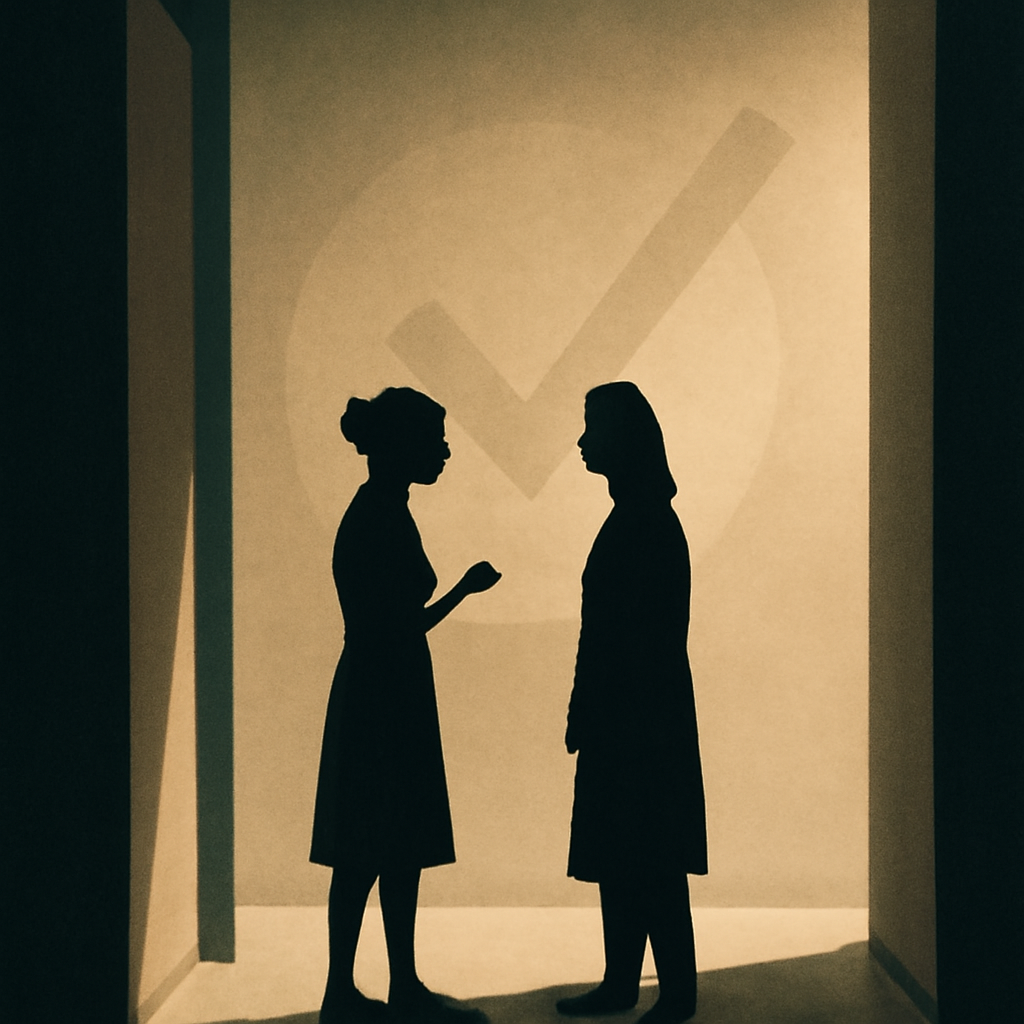
Picture a film where two women meet in a hallway. One asks the other if she’s seen the weather report. The second one says it looks like rain. They part ways. Roll credits on an hour and fifty minutes of men discussing other men. Congratulations, that movie passes the Bechdel Test. It also tells you absolutely nothing about whether women in that story have interior lives, ambitions, friendships, or a single scene where they matter to the plot.
This is the part newcomers to the test often find frustrating, and honestly, fair enough. A ten-second exchange about scheduling, weather, or which exit to take shouldn’t carry the same weight as twenty minutes of two women building a friendship, arguing about a shared goal, or supporting each other through something hard. But under the letter of the test, it does.
Why this keeps happening
Part of it is just arithmetic. Screenwriters know the test exists. Studios know critics and audiences check for it. So somewhere along the way, a line gets added, almost like a compliance checkbox, specifically so the film can clear the hurdle without anyone having to rethink how the female characters are written. It’s not malicious, usually. It’s just the path of least resistance when the goal is “pass the test” rather than “write women like people.”
Why the test wasn’t built to catch nuance
Here’s the thing worth remembering: the Bechdel Test was never meant to be a sophisticated rubric for measuring the quality of female representation. It was meant to be a bare minimum, a quick gut-check, almost a joke with teeth. The entire point of its simplicity is that it’s easy to apply and nearly impossible to defend not clearing. That simplicity is also exactly why it’s gameable.
A test with three strict, binary criteria will always have edge cases where the letter of the rule and the spirit of the rule pull apart. That’s not a flaw unique to this test. It’s true of almost any rule simple enough to explain in one sentence. The trick is knowing when you’ve hit one of those edge cases, not throwing the whole test out because of it.
Borderline cases teach us more than clean passes or fails
This is honestly why the “Borderline” category exists in our database at all, and why it might be the most useful one we maintain. A film that passes cleanly, with women who talk to each other repeatedly about careers, grief, rivalries, plans, whatever, doesn’t need much unpacking. Neither does a film that fails outright because there’s simply one woman in the whole runtime. The technical pass is where the real conversation happens, because it forces you to ask a better question than “did it pass.”
That better question is: would this scene exist if the writer weren’t trying to satisfy a checklist? If the answer is no, you’ve found a technical pass. If the answer is yes, because the scene is doing real narrative or emotional work, you’ve found something closer to the test’s actual intent.

What to look for instead of just counting lines
When we flag something as borderline on this site, we try to look past the raw pass or fail and ask a handful of follow-up questions:
- Does the conversation move the plot or just fill space? A scene that could be cut without anyone noticing is a red flag.
- Do the women reappear together later? One isolated exchange is weaker evidence than a relationship that develops across the film.
- Is the topic substantial? Weather and directions are technically “not about a man,” but they’re also not about much of anything.
- Would the scene survive a gender swap? If the dialogue feels identical regardless of who’s speaking, it’s probably not revealing character.
None of these questions are part of the official three criteria, and they’re not meant to replace them. They’re meant to sit alongside the test, the way a magnifying glass sits alongside a ruler. The ruler tells you if something meets the minimum length. The magnifying glass tells you what you’re actually looking at.
The test is a starting point, not a verdict on quality
None of this is an argument against the Bechdel Test. If anything, understanding its weak spots makes it more useful, not less. A simple pass/fail system was never going to capture everything worth knowing about how a film treats its female characters, and it was never supposed to. What it does brilliantly is start the conversation, give people a shared vocabulary, and make the absence of basic representation impossible to ignore once you know to look for it.
So the next time you watch a movie clear the bar with a single line about the weather, don’t feel cheated by the test. Feel curious about the movie. That reaction, the instinct to ask “okay, but did it actually earn that pass,” is the whole point.